


Buying Land
Table of Contents
If you want to custom-build your home, you should know whether your desired drawing plan can be constructed on the plot of land you plan to buy. Check the zoning (用途地域 Yo-to-chi-iki) rules so you know the local government’s determination of these following factors, which tells you what kind of house can be built on that plot of land.
Factors Which Tells You What Kind of House Can be Built
-
Building Volume-to-Land Ratio
-
Height Restrictions
-
Minimum Lot Size
-
Setback Requirements
-
Fire Resistance Requirements
Land-to-Building Ratio

Land-to-building ratio (建ぺい率 Ken-pei-ritsu) determines how big you can build your 1st floor. However, if the 2nd floor is bigger than your 1st floor then the 2nd floor will be the area subject to this ratio. Parking space is not counted in this percentage as long as it is not a garage or there are no roof and columns over the space. Eaves and roofs that stick out more than 1m from the exterior wall of the house will also be counted as floor space area.
Relaxation to the land-to-building ratio can be granted when a house is built to be fully fire-resistant in a fire prevention district (or built to any similar standard approved by government ordinance), or built semi- or fully fire-resistant inside a semi-fire-prevention district. Separately, if the plot of land is on a corner lot, like on an intersection or deemed alike, and when the city local government has designated the area as applicable, then a 10% relaxation can be granted to the land-to-building ratio.
Building Volume-to-Land Ratio

The building volume-to-land ratio (容積率 Yo-seki-ritsu) determines the maximum possible floor area you can build totaled across all floors of your house. There is a general ratio for each zoning district, but it can be further restricted by the width of the frontal road multiplied by 0.4 in residential zoning districts, or by 0.6 in non-residential zoning districts. The lower of the general ratio and the frontal-road-width-based ratio is the applicable ratio.
Parking spaces are not counted in the building volume-to-land ratio as long as the total carpark area is less than 1/5 of the total floor area across the entire house, where the total floor area in the calculation includes the parking area; whether the parking space is open-air, roofed, or enclosed is irrelevant

Basements are excluded from the total floor area calculation as long as they meet the following conditions: (1) they are within one-third of the total floor area of the entire house, (2) the basement ceiling is less than 1 meter above ground level, (3) they are used for residence.
Height Restrictions
Height restrictions, based on a slant plane, may further restrict the volume of your house, and they are determined differently in each zoning district (用途地域 Yo-to-chi-iki). The restrictions include :
-
Absolute Height
-
Road Boundary Restriction
-
Adjoining Boundary Restriction
-
North-Facing Boundary Restriction
-
Solar Shade Control

Absolute Height Restriction

Category 1 and 2 Exclusive Low-Rise Residential Districts have an absolute building height restriction of 10 and 12 meters respectively.
Road Boundary Slant Plane Restriction
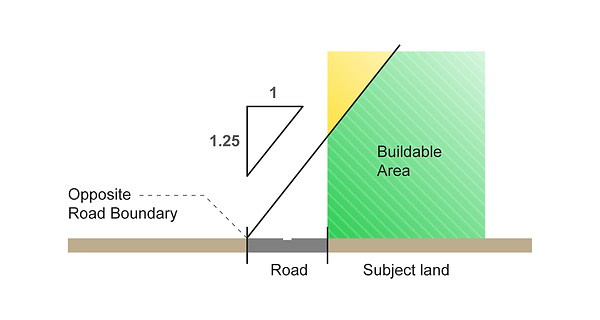
This restriction limits the building height in proportion to the distance between the house and the opposite side of the road they face.
The height must be lower than 1.25 or 1.5 times the horizontal distance between the house and the opposite road boundary.
The ratio is 1:1.25 in residential zoning districts and 1:1.5 in other zoning districts.
Adjacent Boundary Slant Plane Restriction

From a height of 20 or 31 meters, the top of the house must be lower than 1.25 or 2.5 times the horizontal distance between the top of the building and the boundary with the adjacent lot .
The ratio of 1.25 applies to residential zoning districts, while 2.5 applies to non-residential zoning districts.
This restriction is not applicable to Category 1 and 2 Exclusive Low-Rise Residential Districts since they have an absolute height restriction of 10 or 12 meters respectively.
North-Facing Boundary Slant Plane Restriction

This applies only to Category 1 and 2 Exclusive Low-Rise Residential Districts and Category 1 and 2 Exclusive Medium/High-Rise Residential Districts.
In Category 1 and 2 Exclusive Low-Rise Residential Districts, the restriction starts from a height of 5 meters. If there is an adjoining road in the north direction, the top of the house must be lower than 1.25 times the horizontal distance from the opposite road boundary. Otherwise, it must be lower than 1.25 times the horizontal distance from the adjoining boundary.
For Category 1 and 2 Exclusive Medium/High-Rise Residential Districts, the same restriction applies except that it starts from a height of 10 meters instead.
Solar Shade Control

Your house must not cast a shadow on your southerly adjoining neighbor for more than the determined number of hours specified respectively for each zoning district, standardized to between 8 am and 4 pm in the winter solstice.
The restriction is imposed at a horizontal distance of 5 m and beyond from the adjoining plot boundary and at a height of 1.5 – 6.5 m of your adjoining neighbor’s building. Your building shall not cast a shadow for more than 3 – 5 hours at a distance between 5 m and 10m, and 2 – 3 hours at a distance beyond 10m, with the exact number of hours depending on your zoning district.
This restriction is not applicable to commercial and industrial zoning districts.
Other factors that should be considered are the following.
Checklist of Things You Should be Watchful of When Purchasing Land
・Boundary points
・Road Access
・Road Width
・Height Differences with Adjoining Lots
・Accessibility to Utility Outlets
・Soil Conditions
・Climate Risks
Boundary Points
Check if there are clearly marked boundary points with all adjoining lots, and who owns the boundary walls and fences. If there are any doubts regarding boundary lines with the neighbors, they should be cleared up by your seller before contract closing as this may create problems for you in the future.
It is always best to have an official survey map signed off by all adjoining landowners before contract closing, which documents that the boundary points are marked off and they are mutually agreed upon. Even if there is no official survey map provided by the seller, there should still be visible boundary points, and you can ask the seller to point them out to you at the site. If there are any boundary points in question, the seller shall have it determined with the adjoining owner before contract closing.

Road Access

Frontal road and frontages are also important aspects when searching for your property. You should determine not only how accessible the house is with your car, but also whether the frontal road is city approved or not. The latter tells you whether you will be allowed to newly build or re-build (collectively called “develop”) your house. If not, then you will not be allowed to develop a house on that site.
Moreover, the frontal road can either be a public or a private road, even if it is city approved. One thing to keep in mind when you become a joint owner of a private road is that, there may be rising costs to maintain the road which you will have to bear. Conversely, if you don’t own any share of the private road that your house fronts, and, for example, if your water pipes run underneath, you may need permission from the owner(s) to excavate the road when you need to fix or replace them, and you may be charged money for that. It is always best to have your seller obtain written permission from the owner(s) of the private road in advance to consent to you using and excavating the road when repair is needed.

The frontage of your property needs to be at least 2 meters wide (sometimes 3 meters depending on the length of the passage way), or else, a house is not permitted to be developed. You should be watchful for land shaped like a flagpole/battle axe which has a narrow street access. Points worth noting when you buy a house with a narrow street access are, you can be limited to the type of car you can park, and builders may not be able to access the lot with large vehicles carrying construction equipment, which will result in additional work costs for demolishing, redeveloping, remodeling your house in the future. Not to mention that, you may be surrounded in all direction limiting the amount of light the house gets and the view, etc. However, this type of land is generally said to cost 20 -30% less than properties with wider frontages.
Road Width
Within a city-planned area, roads need to be at least 4 meters wide. If your existing frontal road is less than 4 meters wide, or its centerline is less than 2 meters from your lot (or more if stipulated otherwise), you will have to give up land space to make up for the deficit if you ever want to build your house.

Height Differences with Adjoining Lots
You need to look out for any height differences with your immediate neighbors, as you may need to build an earth retainer to align the heights, or build a house with a deep foundation. If there are any old or deteriorating retaining walls between you and your neighbors, they may have to be put up anew as they may not be up to code. The cost for these could be anywhere between a few tens of thousands of yen to few tens of millions of yen depending on the size, structure, materials used, location, etc. You also need to add the cost to remove the existing old walls. For this reason, be sure to find out who owns the walls with your neighbors if there is doubt on who needs to bear the costs of rebuilding them, so that you will be better prepared to stand your grounds.

Accessibility to Infrastructure
When you buy a lot which comes with an old house or an empty lot which had a house once before, you would expect the infrastructure to be there. But the water pipes, for instance, may be too old and at risk of deterioration. So it is best to replace them for your new house. On the other hand, if existing pipes are too narrow, then you may want to replace them with larger pipes to ensure sufficient water flow.
If you are developing a lot which never had a house built on it before, or if your lot does not front to a public road which normally would have the main water, gas, and sewage pipes running underneath them, you will need to connect your utility pipes from where the main pipes are. This could mean you will need to establish infrastructure for the first time, and/or the distance from your lot to the main pipes could be lengthy. The distance and the route it needs to take will affect the overall installation costs. Also, bear in mind that your costs may not just be for the construction itself but there could be a setup fee charged by the Water Bureau, depending on locality, for the new establishment. Furthermore, if you front to or your main utility pipes run underneath a city-owned road or arterial road, since these roads are made thicker because they are busier streets, excavating costs will be higher.
Normally for electricity, the electric company would install electricity wires to your lot for free, establishing an electricity pole if needed to, but this is decided only upon consultation. If any existing electricity pole(s) has to be relocated elsewhere in order to develop your house on your lot because it is inconveniently located, etc., then you would need to obtain prior consent from your neighbors on where that transfer should be. There could be rising costs for it as well.

Soil Conditions
It is important to know whether the soil in your block of land is strong or weak which in turn provides your builder with the information needed for a suitable construction technique and the type and depth of the required foundation of the house. You should be cautious when the land is in low lying types of location where it can be affected by floods and heavy rain.
Whether it needs soil improvement or not will have a huge impact on the overall costs of your construction, and you may have a dispute with your seller in respect to who will bear the costs of improvement. Therefore, it may be a good idea to hire a soil engineer to perform soil testing prior buying the land. However, majority of sellers will not cooperate with such testing out of fear that the results might be unfavorable and they may be asked to lower the sales price, or have to shoulder any costs of conducting such test.
You may want to consider conducting a soil assessment to ensure that the plot of land does not have serious environmental problems such as contaminated soils or polluted water sources. Looking up old maps and closed registries can tell you the history of the land and how it has been used.

Climate Risk
With recent global climate changes, Japan, like many other countries, has suffered from severe floods from unprecedented rainfalls. It is extremely important to make sure your plot of land is not in a flood zone. Not only are floods seen typically in areas near rivers and oceans, but they may also be seen in low lying areas in inland locations, where wastewater treatment capacity cannot keep up with short-time heavy rainfalls which have become more common recently.
Loose saturated sand deposits which are found in reclaimed land, swamps, lagoons, former rivers, coastal regions of big rivers, natural embankment formed from past floods are all prone to liquefaction. Check to see whether or not the plot of land you are buying is in a liquefaction zone which is extremely important to know before making your buying decision.
Given that the prices of real estate in Tokyo are still not reflective of climate risks as much as it should, this is sign of people’s low level of awareness towards frequently occurring natural disasters seen in recent years. It is best you avoid buying real estate prone to natural hazard which could diminish your property values. You should not be blindsided by how great the real estate may look.
